Showing posts with label recycle. Show all posts

1/19/2015

UPPERCASE magazine


I am thrilled to be included in the current issue of UPPERCASE; a magazine all about creativity, design and art. My 'Grandad's Sweater' is featured in a a special section called Scavenger Hunt - creations made from recycled materials. My piece features a refashioned foot stool using granddad's sweaters and clothing.
Issue 24 is all about textiles. It features sections on modern weavers; visible mending; quilt design; the cultural history of vintage feed sacks; tattooed artists and discovering flea market treasures. Each cover has a swatch of vintage feed sack fabric hand-applied to the cover.

UPPERCASE publishes books and magazines for the creative and curious: products that spark the imagination and inspire creativity. Our eponymous magazine, now in its sixth year, is loved by readers around the world and has been recognized for its design excellence. Our books profile up-and-coming artists or explore emerging trends in design and creativity.

We view everything we publish as an opportunity to create something special, so each product has high production values and attention to detail. A playful exploration of creativity, an affinity for vintage ephemera, and a love of typography are some elements common to many of our publications. -publisher / editor / designer Janine Vangool

5/23/2013

Recycled Brooklyn


“An old oak pallet used to be a tree, might have stood in a forest somewhere for 50 years.
It did its job, carried tons of goods all over the world, and now it’s going to the trash heap…?!” 

Matt Loftice of RecycledBrooklyn found green crafting inspiration in New Orleans, Louisiana. Shortly after Hurricane Katrina, he saw an article about a man recovering all of the wreckage to rebuild his home after it was destroyed. 

“Doors, windows, lumber…he was he was grabbing stuff that looked like garbage and making piles near his property, determined to start over using little more than his hands and hard work,” said Matt. Seeing this made him look at old and discarded materials in a new light. “To me, an old door was just an old door – the kind of thing you’d see, step over and just keep going. Stopping to look at it, however, it occurred to me that an old door can be pretty much whatever you want it to be – a desk, a dressing vanity, a coffee table…”

His home in Brooklyn is an endless source for inspiration and materials. “Ideas come and go, a short walk with my dog might become an entire afternoon and then it just kinda happens – a few pieces of discarded plumbing pipe catch my eye. I imagine a standing coat rack and the next thing you know, my dog and I are dragging stuff home.” Besides larger pieces, like doors, he even salvages his hardware and paints.

Check out their online store: recycledbrooklyn.com
Don't forget to like them on Facebook: facebook.com/RecycledBrooklyn

4/21/2013

upholstered chair


Before and after photos of a recent estate sale chair I turned into something special with help from a master upholsterer! The pink Designer's Guild fabric back was brought back from a recent trip to London. I love the combination of the traditional chair and non-traditional fabric. A fun transformation of a one-of-a-kind piece!

10/04/2012

Make Do and Mend


The original meaning for “Make Do and Mend” was created between 1941 and 1949 in Britain during World War II. Adults were rationed to a small number of clothing coupons per year, the price fixed by law. If you had money, but no coupons, you could not buy, although an illegal black-market grew up of traders willing to supply at a price. The repairing and reinventing of clothing and everyday objects that would normally be discarded due to shortages and rationing began in ernest. Wartime rationing of textiles led to the famous campaign which encouraged women to be frugal and clever to clothe themselves and their families. A ‘make-do and mend’ ethos grew up, recycling old clothes, unpicking the wool from old pullovers to darn socks, for example.

The Make Do and Mend booklet was intended to provide housewives with useful tips on how to be both frugal and stylish in times of harsh rationing. With its thrifty ideas and advice on reusing old clothing, the book was an indispensable guide for households. Women were advised to create pretty 'decorative patches' to cover holes in warn garments; unpick old jumpers to re-knit chic alternatives; turn men's clothes into women's; as well as darn, alter and protect against the 'moth menace'.
There are many blogs, artists and businesses that are using the Make Do and Mend philosophyin the present times as a means to recycle, reuse and save materials that usually go to waste.

http://www.makeitandmendit.com
http://www.battleofbritain1940.net/document-3.html
http://www.wornthrough.com
Follow my blog with Bloglovin

8/28/2012

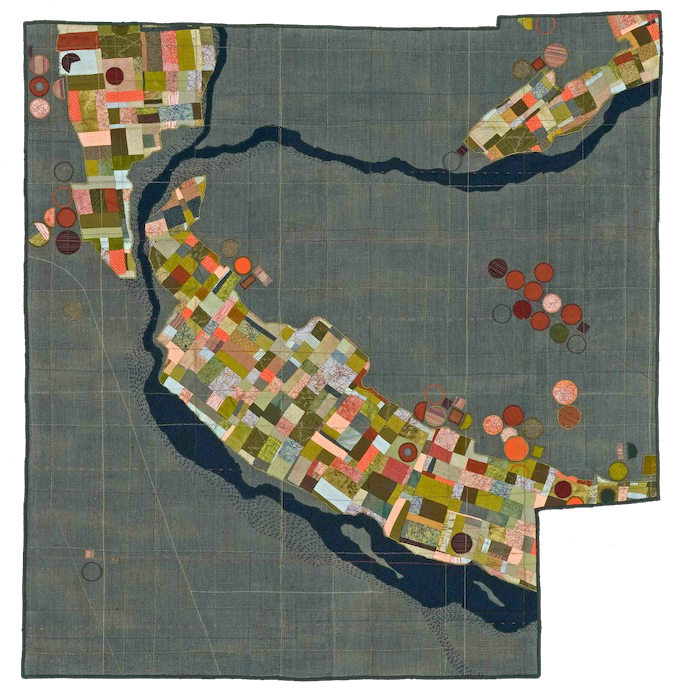
Leah Evans textiles


Artist Leah Evans grew up in the oil refinery town of Augusta, Kansas and was struck by the harsh effect that strip mining for zinc and lead had on the landscape of her home state; "It has left behind troughs that fill up with water and become hazardous wastelands. Despite the danger, some people fish there." What make her quilts interesting is the mix of beauty and the disturbing message underlying them. 

Her artist's statement: My quilted wall hangings consist of layers of the following techniques: appliqué, piecing, natural and synthetic dyeing, needle-felting, hand printing, and a variety of embroidery stitches. There is an overall balance between hand and machine work. Tools I most often employ include a household-use Kenmore sewing machine, chalk, needles, rulers, compass, staple gun, and scissors. I do not use a computer or any imaging software in my work and I try to use hand tools and processes as opposed to electric.

My current work combines aerial photography, maps, and satellite imagery. I also find myself drawn to the more minute systems of the microbial world. I enjoy the play in scale between magnified microbial life forms and remote sensing images of huge tracts of land. Both scales deal with the translation of scientific information into a visual form. At times, these separate bodies of work merge. The overlap is seen in vessel-like arteries of water, tundra pools that look cellular, and microbes that swim through topographic lines.It is the use of maps in organizing our ideas of land that interests me most of all. Often, people ask me for specifics about the places and symbols in my work. Most of my pieces are not based consciously on specific places. For me they are intimate explorations of map language and imagined landscapes. Through my research and experience, I have decided that maps create more questions than they answer.

7/01/2012

Shilpa Chavan


Shilpa Chavan, Mumbai milliner, stylist and designer has transformed objects such as empty plastic bottles, children's toys, rubber flip flops and  underwear into spectacular sculptures that rest upon the body.

“It’s got less to do with being Indian,” she says, “than it is about looking at shapes and objects differently. When I find a shape, be it a rubber slipper or a paper kite, the first thing I think of is how it could be worn on the head. Then I think downwards into jewellery and other accessories like badges, belts…but it really starts with the shape.”

"I don't plan the collections," Chavan says. "I pick up things because I feel they are interesting and then I hoard them. I let them lie for a while until I start feeling strongly about what I can do with a piece, and it can take years to figure that out."


6/08/2012

sari quilting


I answered a Call for Quilters from Sari Bari, a charity based in India and was sent these beautiful preworn saris to use for making a quilt. The quilt will be auctioned off at a Quilt Raffle to help raise funds for the charity.

From their website: Sari Bari is a safe place of employment where women who have been exploited in the sex trade or who are vulnerable to trafficking can experience a new life in the making.
Sari Bari does not rescue women, but rather seeks restoration for those who have been trafficked or held in the sex trade by poverty and lack of empowerment. Approximately 65 percent of women in the red light areas no longer qualify for legal action in the form of rescue. While they were likely first trafficked in their teen years, many are now middle-aged and are trapped by circumstances that have bound them since childhood. We hope to offer high-risk girls an opportunity to life-giving education and work that will protect them from ever entering the sex trade. Additionally, up to 20 percent of Sari Bari jobs at our locations within the city are given to at-risk women who live in the red-light districts. These are usually daughters of women currently in the sex trade, who are uneducated and at a high-risk of being lured or forced into prostitution. 
 
The name "Sari Bari" comes from two symbols. A sari is the traditional clothing worn by women in India. In India, a sari represents the essence of womanhood. The word bari mean "house or home" in the Bengali language.