Showing posts with label fabric. Show all posts

4/21/2013

upholstered chair


Before and after photos of a recent estate sale chair I turned into something special with help from a master upholsterer! The pink Designer's Guild fabric back was brought back from a recent trip to London. I love the combination of the traditional chair and non-traditional fabric. A fun transformation of a one-of-a-kind piece!

9/11/2012

Sari Bari quilters

quilters from Butler,  PA


Maddie Johnson


Kandyce Pinckney


Kate Bretzke & Jill Clayton


Rosie Neave

Kim Day 


Brook Magar 


Cynthia Whitnell


Cathey Newhouse


Cynthia Newman


It was an honor to be among these quilters involved in the Sari Bari Quilt Auction.

Sari Bari: "For this year’s auction, we’ve selected quilt artisans from around the world to create quilts of original design using both new and recycled saris. Their creations are, simply put, amazing."

In October, these one-of-a-kind works of art will be auctioned to the highest bidder. Many quilts will also be listed for raffle—so everyone has a chance to win!
All quilt sales will go toward the purchase a new building in Kalighat, the red light district where Sari Bari’s freedom work first began. You may place your bids at saribari.com at any time during the month of October. Winners will be announced November 1, 2012.

About Sari Bari: Sari Bari is a safe place of employment where women who have been exploited in the sex trade or who are vulnerable to trafficking can experience a new life in the making. The name "Sari Bari" comes from two symbols. A sari is the traditional clothing worn by women in India. In India, a sari represents the essence of womanhood. The word bari mean "house or home" in the Bengali language.

http://saribari.com/blog

9/10/2012

Under the Baobab Tree


Under The Baobab Tree
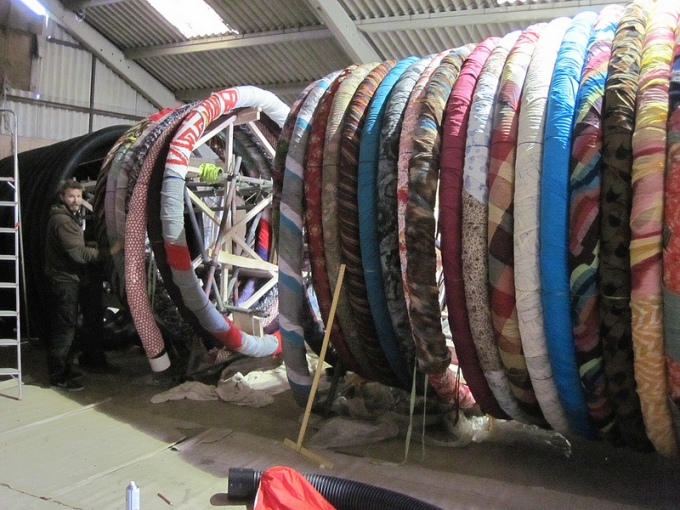
 is now at The Southbank Centre in London and is part of the Festival of the World exhibition. Students from Chelsea College of Art and Design have created the sculpture from stacked rings of fabric from around the globe.  The rings, some 14 feet wide, were used to build the tree before it was covered in 80 different types of fabric. The work was created in a barn and was inspired by Africa's baobab tree, which is a symbol of community. This huge tree sculpture is supposed to reflect the way we live in cities: culture stacked on culture.
Creative director Beatrix Eden: “During the summer of 2012, as thousands of people gather in London, visitors from across the globe will be stepping closer to one another. Inspired by the idea of the space between strangers becoming smaller we created the Baobab Tree as a unique meeting place for chance encounters sparking new conversations. Every culture uses fabrics and patterns, whether in traditional dress, uniform or decoration. Fabrics have always travelled, designs crossing borders, being altered and traded back. Within the fabric of our tree we hope that visitors will recognise threads from their own cultures woven into this meeting place at the heart of a global gathering.”


Building the sculpture: http://www.youtube.com/watch?v=-hGsFf0XDKs&feature=relmfu
About the fabric designers: http://baobab.staticloud.com

8/28/2012

Leah Evans textiles


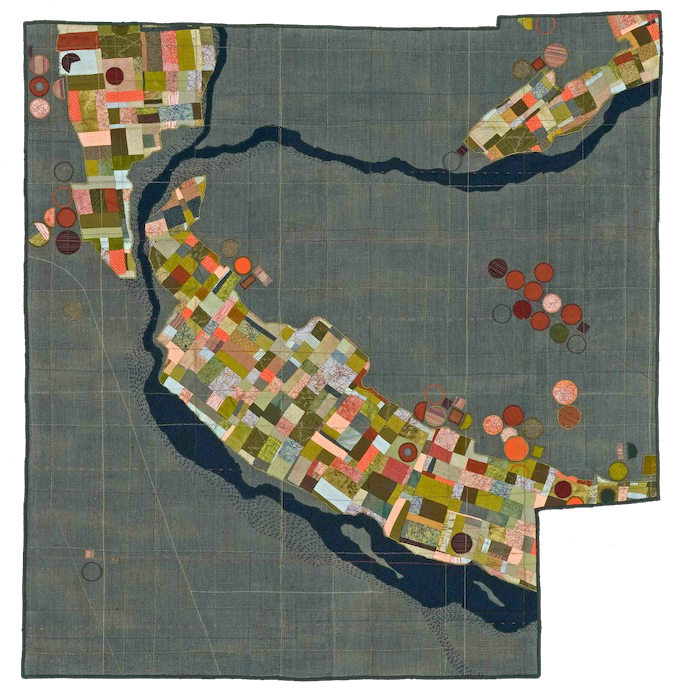
Artist Leah Evans grew up in the oil refinery town of Augusta, Kansas and was struck by the harsh effect that strip mining for zinc and lead had on the landscape of her home state; "It has left behind troughs that fill up with water and become hazardous wastelands. Despite the danger, some people fish there." What make her quilts interesting is the mix of beauty and the disturbing message underlying them. 

Her artist's statement: My quilted wall hangings consist of layers of the following techniques: appliqué, piecing, natural and synthetic dyeing, needle-felting, hand printing, and a variety of embroidery stitches. There is an overall balance between hand and machine work. Tools I most often employ include a household-use Kenmore sewing machine, chalk, needles, rulers, compass, staple gun, and scissors. I do not use a computer or any imaging software in my work and I try to use hand tools and processes as opposed to electric.

My current work combines aerial photography, maps, and satellite imagery. I also find myself drawn to the more minute systems of the microbial world. I enjoy the play in scale between magnified microbial life forms and remote sensing images of huge tracts of land. Both scales deal with the translation of scientific information into a visual form. At times, these separate bodies of work merge. The overlap is seen in vessel-like arteries of water, tundra pools that look cellular, and microbes that swim through topographic lines.It is the use of maps in organizing our ideas of land that interests me most of all. Often, people ask me for specifics about the places and symbols in my work. Most of my pieces are not based consciously on specific places. For me they are intimate explorations of map language and imagined landscapes. Through my research and experience, I have decided that maps create more questions than they answer.

2/20/2012

artist Barbara Wisnoski


Beautiful textile work from artist Barbara Wisnoski.
Artist Statement: “Happily freed from precision, this is cutting and sewing as mantra, as pure, riotous activity.
I harness traditional textile-piecing techniques to explore structure and process, and the interplay between surface and depth. As structure, these pieces juxtapose tactile and pictorial fields. As maniacally repetitive process, they embody the meaning I derive from textiles and ritual, and carry contradictory connotations of repetition’s beauty and innate absurdity..

I am interested in the relationship between texture and time. The process of building a piece, whereby a fabric loses its singular quality and becomes part of the whole, reminds me of how time washes a harmonious patina over objects and memories. The prospect of decay is key to the work: seeing how pieces done long ago have changed over time reminds me that they were made from living fibres and, like us, evolve and deteriorate. Also like us, these pieces become more themselves, therefore more beautiful, with age."

From an interview: "I create murals and wall installations from repurposed clothing using a method inspired by traditional quilt-piecing techniques. Cloth is sewn together and then repeatedly slashed apart, re-sorted and re-sewn, fracturing and dispersing individual fabrics in a process that melds surface and structure, and embodies the beauty, comfort and absurdity of repetition."

http://www.barbarawisnoski.com

12/04/2011

artist Emilie Faif


I'm very intrigued with these works by French artist Emilie Faif.
To see more of her creations and her bio check out her website: http://emiliefaif.com/index.html